Become a client
Brussels sets the political rules – companies have almost no say in this process
Whether trade agreements, CSRD, CSDDD, CBAM or emissions trading: the decisive political decisions for business are no longer made in Berlin, Paris or Warsaw – they are made in Brussels.
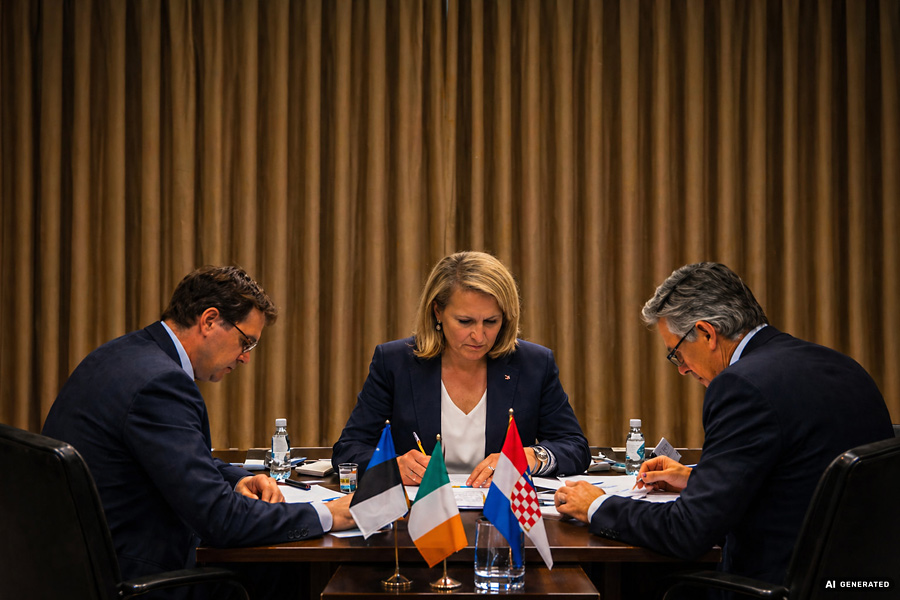
Today, 89% of all EU legal acts are concluded after the first reading within the EU’s ordinary legislative procedure – largely based on the outcomes of the so called informal trilogue. In these non public negotiations, the European Commission, the European Parliament and the Council of the EU agree in advance on the final legislative text.
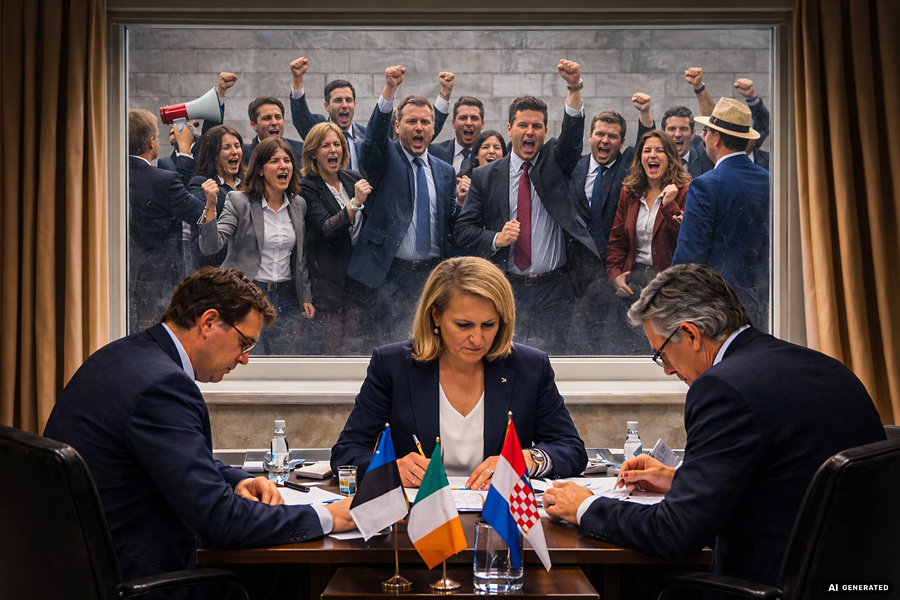
Companies are not formally involved in this process.
The best arguments are ineffective if they do not reach the decision-makers
Many companies respond reflexively to increasingly burdensome EU regulation by allocating additional resources to their in‑house government relations teams, trade associations, public affairs agencies or lawyers. This improves the quality of arguments – but not necessarily the results.
Those who only refine their arguments “outside the house” do not automatically gain access “inside the house” when decisions are taken. And those who fail to place the right arguments with the right decision-makers at the right moment will see their position dissipate.
Do you have questions or are you interested?
With process competence, regulation becomes a tailwind for your business model
EUTOP possesses reliable access to >3,500 decision-makers and a deep understanding of all formal and informal decision-making processes: To achieve this, EUTOP works exclusively with more than 80 structural advisors (i.e. former senior decision-makers from the European Commission, various political groups of the European Parliament, as well as national governments, ministries, and parliaments). This ensures your issues reaches the right decision-maker at the right time in the EU decision-making process.
EUTOP speaks the language of politics: In 85–95% of cases, your issue is fundamentally capable of gaining majority-support. Using the OnePager® methodology, we prepare your topic on a single page in a way that convinces political decision-makers from a public-interest perspective and thus becomes capable of gaining a majority in practice. Only in this way can your issue become the issue of politics.
EUTOP stands for excellent project management: EUTOP accompanies the entire political process strategically and operationally. From the first signal to the final decision. Around the clock and with a clear focus on results.
Leading companies, associations and organizations have been relying on the EUTOP methodology for decades
(Transparency Register (EU): EUTOP Europe GmbH) (Lobby Register (DE): EUTOP Europe GmbH)




















Conditions for becoming an EUTOP client
Before EUTOP enters into a cooperation with a new client, two conditions must be met without exception:
- There must be no conflict of interest with one of our long standing existing clients.
- The issue must be convincingly translatable into a majority capable, public interest perspective from the point of view of the relevant political decision-makers.
Then we are confident that we can deliver on our success commitment.
Our offer to you
EUTOP offers its clients three types of services:
- Active Interest Representation Project (IRP): Successful support of the representation of your interests based on the process competence described above.
- Information Management (IFM): Procurement, analysis, use, communication and protection of information.
- Contact Management (CM): Securing and professional management of 24/7 access to all key stakeholders. Effective contact management is based on a resilient, trust based network of all relevant stakeholders, built up over many years of cooperation. Structural Advisors further expand this access.
Depending on focus, complexity and effort, the following service packages are offered:
Service package
1a) High-End
1b) Premium
1c) Standard
2) Reinsurance
3) Network Access
Focus
IRP
IFM & CM as part of IRPs only
IRP
IFM & CM usually of medium relevance
IRP
IFM & CM usually of higher relevance
IFM & CM
IRPs selectively
IFM & CM
IRPs selectively
Complexity & Effort
Very high – high:
Numerous, workstream‑ based IRPs or 1–2 highly prioritized IRPs with (very) high strategic complexity, use of Structural Advisors, steering, and coordination effort.
High – medium:
Several IRPs with high to medium strategic complexity, use of Structural Advisors, steering, and coordination effort.
Medium – low:
Few IRPs with medium to low strategic complexity, use of Structural Advisors, steering, and coordination effort.
Low:
No or few IRPs with low strategic complexity, occasional use of Structural Advisors, steering, and coordination effort.
Low:
No or few IRPs with low strategic complexity, ongoing use of Structural Advisors, steering, and coordination effort.